

Hearty Meals Lessons Learned
- Dec 13, 2016
- 6 min read
Lessons Learned
By Janna Bico, Joni-Lynne Lopez, and Gizelle Pastoral

Problem statement.
Hearty Meals “How Might We” is How might we improve self-management of CHF patients at home post hospital discharge?
As cardiac nurses, we are passionate about the health education of our CHF patients. From what we observed in our hospitals, we found that patients and families tend to be concerned about what they will eat when they return home. No matter how much education the hospital nutritionist can give them, they are still worried about not having enough time to shop for groceries and not knowing how to prepare a healthy meal. In the beginning stages of this project, we examined two personas. They were both people living with heart failure and had the common problem of lacking motivation carrying out daily activities. An activity such as eating a meal with their families or even on their own became a struggle, which then lead to carelessness with their diet.
What problem are you solving?
Many patients diagnosed with heart failure struggle with self-management of their condition once they return home from the hospital. Keeping a healthy, low-sodium diet is a key issue that heart failure patients face. The Hearty Meals program will allow heart failure customers to have easy access to heart healthy meals by delivering low-sodium recipes and pre-portioned ingredients straight to their homes.
Why is it THE problem?
Eating too much sodium causes the body to keep or retain too much water, worsening the fluid buildup that happens with heart failure. This leads to drastic symptoms such as shortness of breath, fatigue, edema, and extreme weight gain, which ultimately leads to long and frequent hospitalizations. Heart failure patients encounter this issue with every meal. Eating a heart healthy diet can be difficult to do if they are not aware of monitoring or how to measure their sodium intake.
Describe how you arrived at this specific problem.
As our group continued to brainstorm, we focused on what motivates heart failure patients to maintain their self-management at home. As cardiac nurses, we know that hospital readmissions is a problem with heart failure patients. One of the biggest problems is keeping a low-sodium diet along with continuing to take medications in order to keep their CHF symptoms under control. We found that heart failure patients lacked education, motivation, and awareness in simple everyday tasks, such as preparing a meal for themselves. When patients are discharged, they receive instructions for their medications and follow-up appointments, however they do not receive daily instructions for every meal. This leads to patients having difficulty adhering to low salt heart healthy meals, eventually sending them back to the hospital. Our group concluded that patients may have difficulty being compliant in taking medications or measuring their vital signs- but one of the most common problems is in their control over their eating habits.
What else did you consider before narrowing down to this?
We considered creating a mobile app geared towards medication compliance, daily weights, and vital signs. However, we did not find it appropriate because our population is older (65 years and above), and using a mobile app may not be the best solution for our patients.
Solution overview.
Succinctly describe your solution - how do you describe what you’ve built in 30 seconds?
For our very first prototype, we started with a box - or the idea of a box, and began to cut out pieces of paper that will represent the contents in the Hearty Meals package. The pieces of paper were labeled with ingredients and recipe cards. Then we added a sodium card and a CHF tip card as part of our goal in educating patients.
Describe the final design.
Describe the functionality (i.e., what you can do with it)
Each Hearty Meals package is delivered with a recipe card, sodium card, and CHF tip card. The recipe card contains the total calories of the meal, servings, time to cook, ingredients, and recipe instructions with pictures. A Hearty Meals package also contains pre-portioned ingredients that are labeled, which makes cooking simple and easy.
In addition to designing our package, developed our Hearty Meals website which will be utilized for customers to order their weekly meals. It is a simple design, where users are able to choose meals from breakfast, lunch, or dinner.
Provide a description of the main parts of the design flow.
This is important because it will provide you with a record of how the design worked or was intended to work, long after the implementation no longer works. It could in principle also act as a deliverable to hand off to an implementer.
The main parts of the design flow involved the cards that come with the package and the Hearty Meals website. We wanted the cards to be easily readable, replacing long recipes with pictures and short phrases as much as possible.
What was left unimplemented?
Our group did not have enough time to explore the idea of collaborating with local supermarkets to supply our produce. We were unable to implement this aspect of our delivery plan.
What was your approach to collaboration?
Due to hospital policies, we were unable to integrate social services. However, we collaborated with staff and patients from our workplace to provide us opinions on what we can do to improve our Hearty Meals package.
Tool(s) you used to develop the design.
We looked at the current educational material that heart failure patients receive at the hospital and assessed patients for what they learned and how they practiced self-management at home. This tool helped us create the CHF Tip and Sodium level cards. Other tools we used were free website builders such as Wix, Staples’ printing department and Vistaprint.
Pros and cons of these approaches and tools for your project
Pros: Our design goal was to create a package as close to the final product as possible. Our tools allowed us to build a physical package and a website.
Cons: Wix had many barriers in allowing us to create a website exactly how we would like it due to premium subscription fees. For example, we have to pay to be able to add more than one question for the CHF quiz. Wix also prevents us from enabling other features such as online ordering. The cons about Staples and Vistaprint is that it can be costly and time-sensitive, such as waiting for our Hearty Meals logo stickers to arrive in time for creating a prototype.
Design Evolution.
Describe how your design changed from initial sketches, brainstorming, low-fidelity prototype, to final design.
We researched many pictures and recipes, referring our guidelines back to American Heart Association, but also concentrated on making the final cards clean and simple. This involved editing the recipes to shorter phrases and Google searching countless pictures. We also had to make sure the recipes we chose looked appealing while adhering to low sodium content. A challenge was creating the sodium level chart that would be in the package. We chose two recipes that we would be presenting as a final product. In our first prototype, our ingredient labels were hand-written and the Hearty Meals logo was printed on a piece of paper which was then taped onto a box. The final product has a laminated recipe/sodium level/CHF tip card and we printed official logo stickers and labels using Staples and Vistaprint. We also thought more about the packaging for the final product and added a water-resistant box liner and ice packs.
Our first prototypes:

Show what the major changes were and why they were made.
A major change involved our website. We added a completely new page dedicated to Customer Rewards, after receiving feedback on how we can keep loyal customers. Another change we made was putting the recipe, sodium level chart, and CHF tip card all on one sheet. This will take up less paper and make it easier for people to organize in their homes.
Hearty Meals website:
Able to order from breakfast, lunch, or dinner
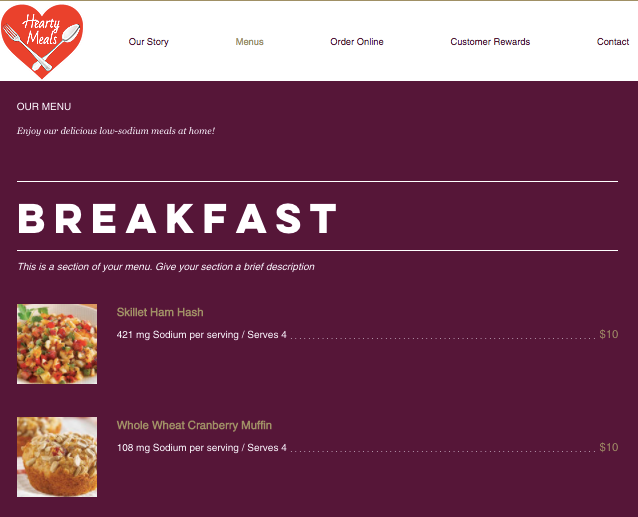


Clicking on each meal displays the nutritional info & amount of servings

We provide customer rewards through quizzes and holiday promotions

c. Relate your design process and choices to the readings.
During week 3, we read about creating personas, which helped us envision our users’ needs, goals, and interests. We took our personas’ pain points and focused making our solution around it. During week 6, we read “Make It Real” which gave us an overview of prototyping. We found this article helpful because it explained step-by-step what ideas and tools we need to gather in order to make our first prototype. The article gave tips such as “Don’t get too attached to your idea” and “Listen to your audience”. Those tips helped us explore changes that ended up improving our feedback.
5. Measuring Success.
a. Are you happy with what you all made? Why or why not?
Yes, we are satisfied with our project. Our group is confident that Hearty Meal packages will help CHF patients to eat low-sodium hearty meals and will be more aware about CHF through the Sodium card and CHF Tip card. The peak of our project was when we were able to finally test out the Hearty Meals package with Joni’s parents. Seeing them prepare a meal from everything that was in our box was exciting to see.


PDF document - Assignments section of NYU Classes
link to your prototype: https://youtu.be/M8vu366Cenw
http://gap338.wixsite.com/heartymeals


Comments